It feels a bit weird to post stuff to this here blog. Seems very twenty oughts. But the content that follows seems better suited to a blogpost than a social media post. So here goes.
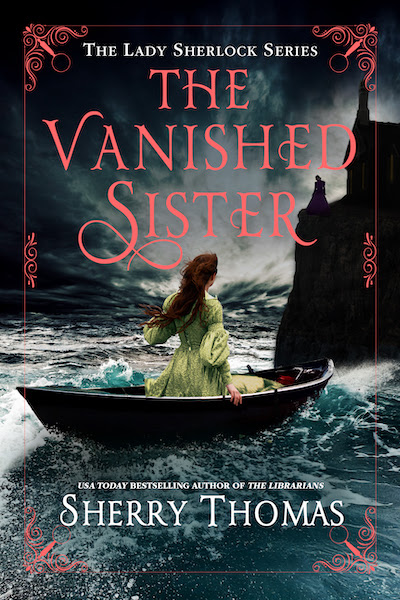
The Vanished Sister, book 9 in the Lady Sherlock historical mystery series, releases on September 29, 2026. And I want to celebrate by recounting a little research trip I undertook on its behalf. 🙂
This is something readers may or may not know about me: I used to be a Google Earth writer. I’d never visited Britain, for example, until the summer of 2014, after all my historical romances had been published. I remember walking around in Eton, which featured heavily in book 1 of my young adult fantasy series, also already published by then, thinking, this looks a bit different from what I’d been led to believe by my research books! 
At least no one alive now remembers for sure what London and its vicinity looked like in the late Victorian era.
In the one and only contemporary romance I’d ever written, I had the main characters, on the island of Capri, walk to Villa Jovis, the ruins of a Roman palace once beloved by Emperor Tiberius. I even had the MMC encounter his estranged parents there too.
Why Villa Jovis? The images on Google Earth, back when it had that rich Panoramio layer–RIP–were stark and beautiful and I was instantly smitten.
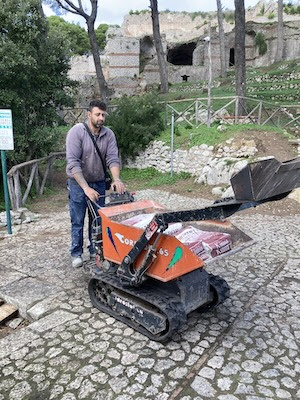
In 2023, almost ten years after the book came out, I finally got around to Capri myself, undertook the same rather long but very lovely walk, on vias that were literally the width of the desk I’m typing on, and saw Villa Jovis with my own eyes.
The images had not lied. The place was stark and beautiful. But it was also really remote and rather desolate. Granted, it was a set of ruins. But the entire time I was there, I saw only one other tourist. There were more people working as caretakers on the premises than there were visitors.
Nobody was accidentally running into their extranged parents in this place, unless everybody involved was an archaeology enthusiast and/or Roman history aficionado.
Had I visited Capri before setting part of my story there, I’d have engineered the encounter to take place at the Gardens of Augustus (fka Krupp Gardens). A lot less original perhaps and a bit more tourist-trappy, but it was much more likely.
After that I resolved to be a bit less of a Google Earth writer. After all, my children were now grown and my time had become more my own.
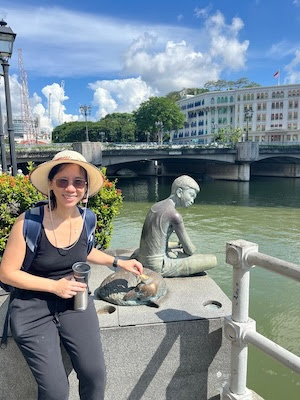
So in 2024, before we finalized The Librarians, I spent a couple of days in Singapore, to make sure the few scenes set in the Lion City wouldn’t come across as egregiously wrong.
In 2025, I was laboring over various drafts for The Vanished Sister. Other than the usual problems early in the process, I also had to come to terms with the fact that Lord Ingram’s seaside cottage, which had an important role to play in the story, was described thusly in A Conspiracy in Belgravia, book 2 of the series:
When he returned, she stood at the edge of the garden, her hands on the rails, admiring the view of the Hangman cliffs.

I was talking about this view, which sets the cottage at a rather specific spot on the North Devon coast, right near the town of Combe Martin. A real place, not a made-up spot for which the topography could be created to suit the needs of the story.
Unlike Eton and Capri, I’d already visited Combe Martin twice: It is part of a breathtaking stretch of the South West Coast Path, and I would like nothing more than to hike its entire 630-mile length someday.
But also, I hadn’t been there since 2018, which, after the Pandemic, felt like twenty years ago.
As I kept zeroing in on the landscape in a Google Earth that had lost its Panoramio photos layer, it occurred to me that perhaps I ought to simply visit Combe Martin in person, especially as I was already going to be on a transatlantic cruise in October which would have two stops in the UK.
(When people think of cruises, they probably conjure a ton of tipsy passengers partying by the pool, thousands of kids running around, and whatnot. But when kids are back in school, cruises are much less crowded. And for repositioning itineraries, which see ships in Europe head for Florida and the Caribbeans in autumn or in the other direction come spring, the ships are never full and the passengers are old and calm. These cruises are in fact an introvert’s paradise, perfect for reading and writing by the 24-hour buffet, abandoning all that only for long walks on the promenade deck, with the sea unfurling from horizon to horizon.)
(My mom considers these same cruises an extrovert’s paradise, btw. She goes to 4-5 dance/exercise classes a day and meets dozens of passengers from all over the world.)
(And you can get terrific deals for repositioning cruises too, since they’re not most people’s idea of a fun time.)
My original plan was to get off the ship at Portland, UK, get to Combe Martin via a combination of trains and buses, and spend the few hours of remaining daylight investigating the lay of the land. And then, once it became too dark to see, to cover as much of the distance to Falmouth, UK–where I would reboard the cruise ship–as possible that evening, and finish the remainder of my journey the next morning. (It was imperative that I caught the ship in Falmouth, because that was the last stop before the transatlantic portion began!)
But cruise itineraries are only ever proposals. All of a sudden we learned that a particular port of call was no longer possible due to a dock workers’ strike. The replacement destination? Dover, UK, two days before Portland.
I was ecstatic. This gave me a whole day to spend on the coast, rather than a few harried hours. And I wouldn’t have to worry about not making it back to the ship for the Atlantic crossing.

From Dover, I took the train into London, and soaked up the Victoria and Albert museum, where I saw this eye-watering tea service which Charlotte Holmes would have happily made an heirloom of her house.
That night I slept in Exeter, in a little hotel just opposite the train station. In the morning, I finished the few mini pastries that I’d brought with me and got on the train again.
The railway journey through the West Country was so pretty. And the bus ride from Barnstaple to Lynton/Lynmouth was just spectacular. I’d forgotten how deeply and dramatically folded the landscape was–which was exactly why I needed to see it again in person.

I meant to buy some Cornish pasties from this little shop in Lynmouth that specialized in them. But the shop was closed on Mondays and it was a Monday. Well, no matter. This was the South West Coast Path, where one was never more than a few miles from a pub, or even better, an establishment that served a good cream tea. We were in Devonshire, after all, of the clotted cream fame.
(She does not get cream tea, says the omniscient narrative voice. She does not get anything.)
My goal for the day was to walk from Lynmouth to Combe Martin, two important locations in the book.
Google Maps told me these two places were ten miles apart, btw.
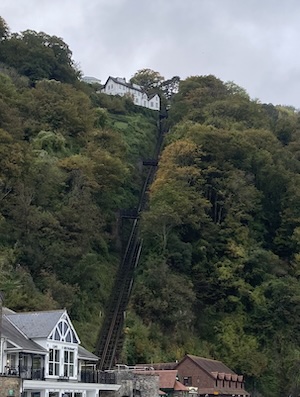
I started my trek by climbing up a gigantic cliff. If I’d thought about it, I’d have got off the bus in Lynton, on top of the cliff, and not Lynmouth, at the bottom. It was so steep that people built a cable car in the Victorian era that was still in use. But I was there to investigate things on the ground, so I climbed.
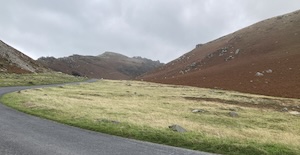
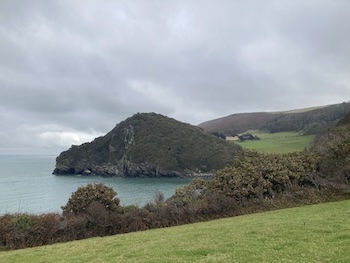
The weather was perfect, overcast and in the fifties. I traversed the otherworldly Valley of the Rocks (right), walked past Lee Abbey, nestled so prettily in a little hollow along the craggy coast, and trampled up and down a lot of pastureland and saw lots of sheep.
The ground was never flat. I was sustaining either a long ascent or a long descent. And once I left the Lynmouth/Lynton area, in the several hours that followed, I came across only two people. One, a determined-looking woman with an enormous backpack and two hiking poles, going in the opposite direction, and the other, a man who passed me just when I was starting to wonder how much more distance I still had to cover before I reached Combe Martin.
(I’d never walked the South West Coast Path by myself before, but had always been with my family. As I made my way down more and more tricky slopes, I realized the danger of doing this alone wasn’t that I was a woman, but that if I twisted my ankle I couldn’t make a phone call–no signals–and that no one would come by maybe until the next day!)
About four hours after I started, I got down into a deep, narrow combe with a small river at the bottom. I looked around. The place looked familiar. Granted, the entire stretch of coast looked familiar because I’d walked it before, in 2018, but somehow this particular spot felt like I didn’t just pass through but spent some time here.
But then I saw the next signpost. Combe Martin 8. Eight more kilometers? I suppose I could walk eight more kilometers but I’d best hurry if I wanted to make the last bus from Combe Martin that would take me back to Barnstaple, where I’d catch the train back to my hotel in Exeter.
I patted my now empty stomach and started up the next great bluff.
Halfway up the bluff, something weird happened. The man who had passed me on the previous bluff, passed me again. This was perplexing. Where did he go in between?
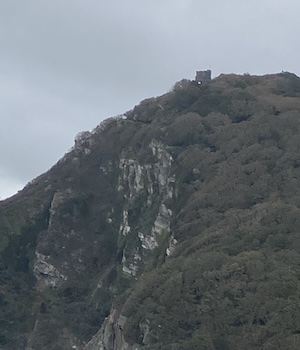
The bluffs only grew taller and bigger. I became extremely grateful about the cool weather because not only did I not have any food with me, I only had a single Contigo travel mug of water.
Then, in the next couple of hours, a slew of realizations hit me. First, I was no longer on continental Europe where my cruise had started, but in the UK, the home of the imperial system. From the point of the signpost, I didn’t have eight kilometers to go, but eight miles, which was 60% longer!
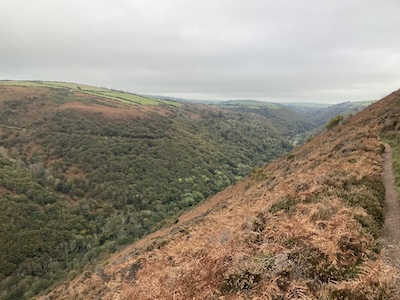
Two, Google Maps’ estimated distance was not along the South West Coast Path. The geography of the coastline was ginormous bluffs separated by deep, narrow combes. (Sample valley to the left.) One had to follow paths that wrap around each bluff, going half a mile or more inland into each valley, before switching directions and getting on the path that winds around the next bluff. I was going to walk a lot more than ten miles this day.
Three, I did remember that spot. On the same signpost that told me Combe Martin was eight miles away, a different arrow pointed to a sea cove called Heddon’s Mouth. In 2018, we’d broken our journey there and Jr. Kidlet and I had even built a little tor in that rocky cove.
Which meant that four, had I realized it and walked half a mile more inland, I could have found the hotel where we’d stayed at. And had myself a lunch. Or at least a cup of tea with a couple of cream scones. (You can just barely make out the outline of the hotel on the picture above.)
Five, the gentleman who passed me twice? That must be exactly what he’d done, taking a nice little break at the hotel before carrying on to wherever he was headed!
And six, alas, it was too late to walk back to the hotel and I might as well carry on.
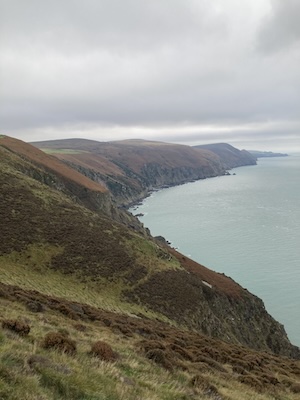
Those were eight long miles, because I was now racing against time. At first I kept looking at my watch because I didn’t want to miss the last bus from Combe Martin. And then I had a bigger problem. I was going to miss the bus for sure. But would I be able to make it back to civilization before night fell and it became too dark to see?
By the skin of my teeth.
I stumbled into a convenience store, twelve hours after I’d last eaten, grabbed a refridgerated cornish pasty that was expiring the next day, heated it up in the microwave, and gobbled it down.
I ended up taking a cab–thank you to the lovely English people who helped me get the cab because my phone was still useless–to Ilfracombe to take the bus from there to the nearest train station. And boy, if I’d known I’d have ended up taking a cab, I could have taken it from the hotel I’d bypassed in my ignorance, right after that mythical best lunch of my life!
According to my Fitbit, I walked more than 17 miles that day, and racked up more than 45,000 steps, fueled by nothing more than a few mini pastries.
(In case you’re wondering, I made it back to the ship the next day.)
Okay, but was all that heroic hiking helpful to the book?
Let’s review the plot of the book.
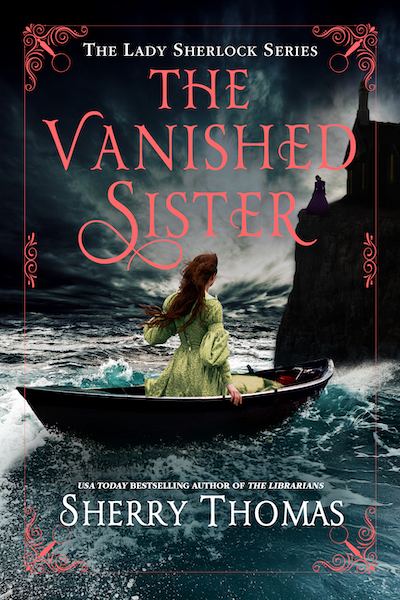
It’s been three years since Charlotte Holmes struck a decisive blow against Moriarty’s operations in Britain, three years of relative calm and benign developments. In a buoyant mood, everyone gathers at Lord Ingram’s seaside cottage in North Devon for what promises to be a perfect summer holiday. Until Mrs. Watson receives an invitation from Mrs. Carstairs, her long-estranged sister, to attend a house party nearby.
Mrs. Carstairs has married spectacularly well. She is the mistress of a great manor, a doyen of all domestic arts, and still an unforgettable beauty. Now she clamors for a reconciliation with her sister. Mrs. Watson does not trust Mrs. Carstairs’s motives. Yet she cannot help but feel tremors of the old admiration for this once-beloved sister.
Then Mrs. Carstairs disappears without a trace. The next day a woman is discovered floating on the waves, her build and coloring matching those of Mrs. Carstairs. But her husband insists that the corpse fished out of the Bristol Channel cannot be his wife. So where is the real Mrs. Carstairs? Would she have purposely dragged Mrs. Watson into a murder investigation? Or was it Sherlock Holmes’s involvement that she needed from the very beginning?
And the answer is a resounding yes! On the ground, it was very clear what was and wasn’t possible when it came to a body and all those craggy cliffs. I.e., those craggy cliffs were not vertical and they were fully covered by heathers and gorses and other plants so I had to get creative about how a body got into the waves
Find out how by ordering your copy here. 😀
I hope you have enjoyed this account of my little adventure–what doesn’t strand you in the wilderness makes for a good story down the line. 🙂 I hope you will also enjoy The Vanished Sister!